
When the heating will not come on, the cause is usually one of three things: the boiler, the controls that tell it when to run, or the electrics feeding them. A few simple checks will often tell you which, and sometimes fix it. They also tell you who to ring, because a fault inside the boiler or on the gas is a job for a Gas Safe registered engineer, while the supply to the boiler, the thermostat, the programmer and the wiring between them are electrical.
Start with the simple things
Before anything else, check the obvious. These catch a surprising number of “broken” heating systems, especially in autumn.
- Is the thermostat turned up high enough? Turn it a few degrees above the room temperature. You should hear a click, or see a light or symbol on a digital thermostat, and the boiler should fire within a minute or two.
- Does the thermostat have batteries? Many wall and wireless thermostats run on AA or AAA batteries. A blank or faint screen is the clue.
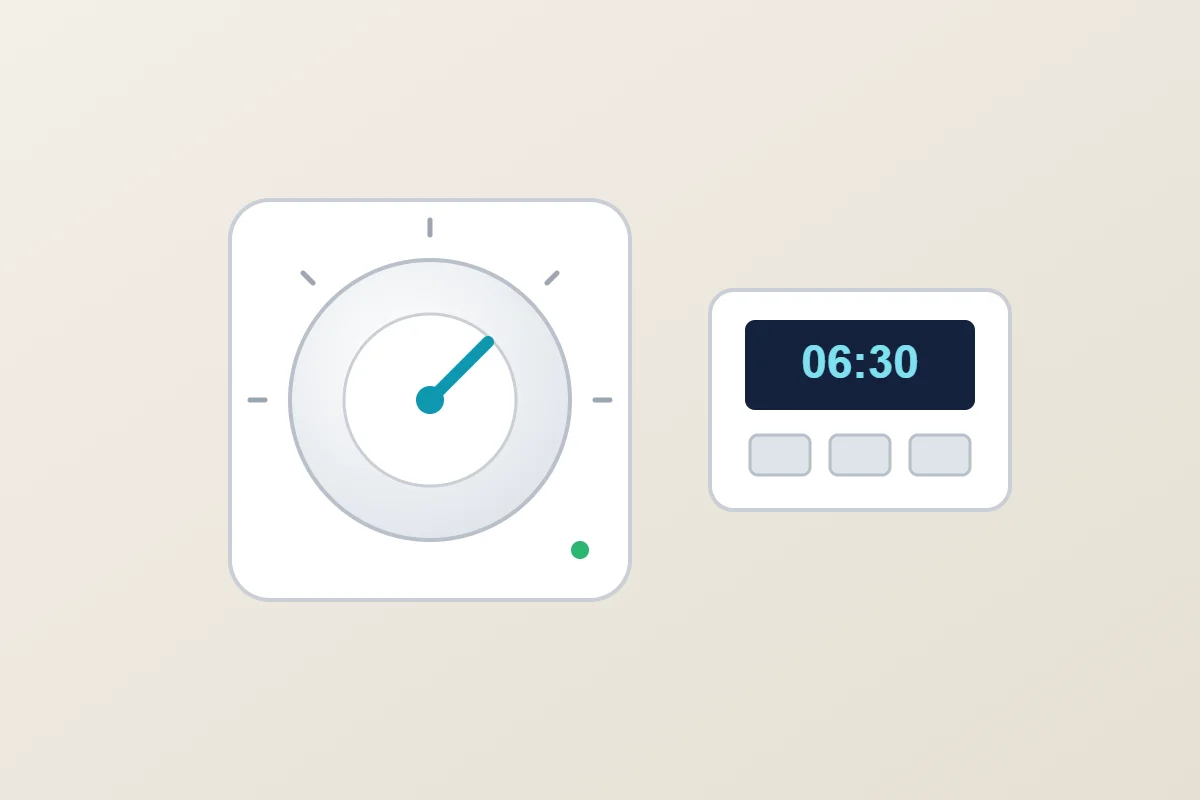
- Is the programmer set to the right time and day, and switched to heating on? After a power cut, or when the clocks change, some programmers lose their time or run an hour out. The clocks go back on Sunday 25 October 2026, so it is worth checking yours that week.
- Is it set to “heating” or just “hot water”? Many programmers and smart apps control the two separately.
- Has someone used the app? Smart thermostats can be put into away mode, a holiday schedule or a frost setting from a phone, sometimes by someone else in the house.
Is the boiler getting power?
Look at the boiler’s display or lights.
If the boiler display is completely blank, it may not have power.
- Check the boiler’s own on/off switch, if it has one.
- Find the switch for the boiler on the wall nearby. It is usually a switched fused spur, a white switch with a small fuse holder, sometimes labelled “boiler” or “central heating”. Make sure it is on.
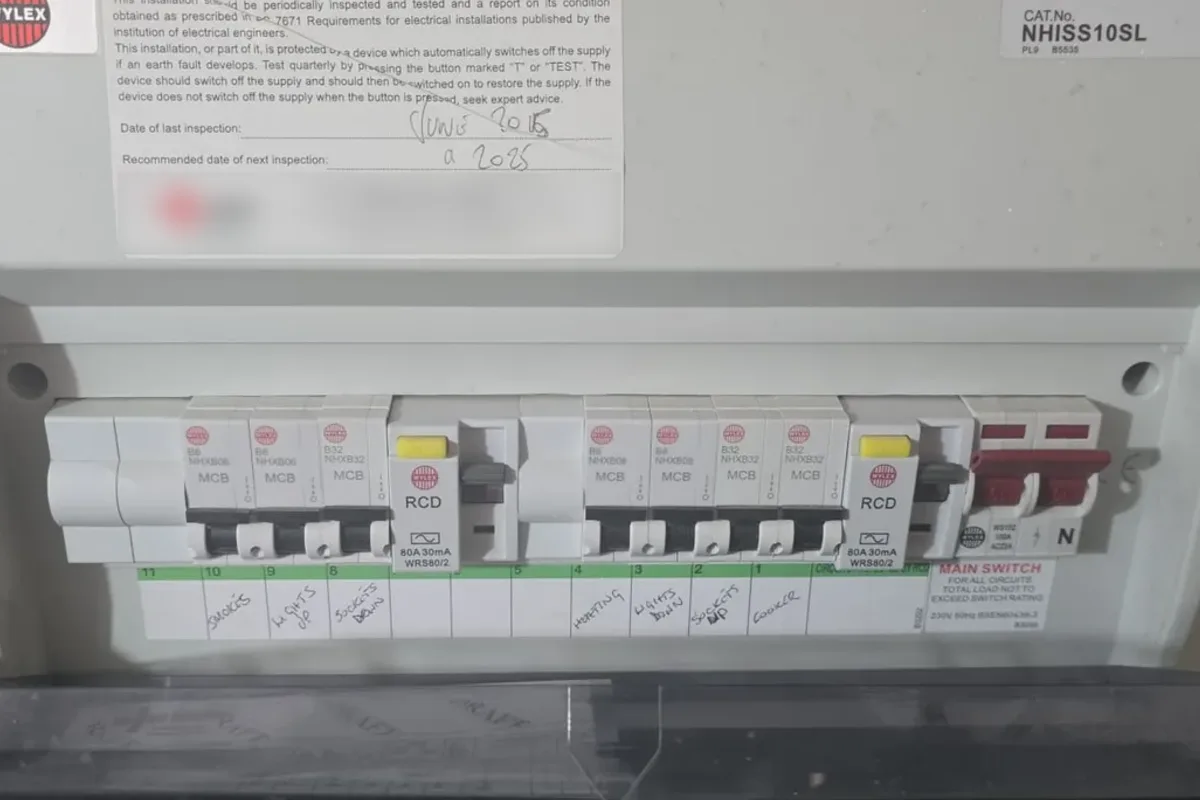
- Check your fuse board. Look for a tripped circuit breaker or RCD, particularly one labelled boiler, heating or similar. If the RCD has tripped, our article on why an RCD keeps tripping explains what to do.
If the switch is on, nothing has tripped and the boiler is still dead, ring an electrician. If the fuse in the spur or a breaker at the board keeps going, leave it off and ring one. Do not keep replacing fuses or resetting breakers.
If the boiler display is on and showing a fault code, look up the code in the boiler manual or on the manufacturer’s website. That usually tells you straight away whether it is something you can sort, such as low pressure or a frozen pipe, or whether you need a heating engineer.
Two boiler problems you can often sort yourself
These are not electrical, but they are common enough that they are worth knowing.
Low pressure. Most combi and system boilers run on a sealed system with a pressure gauge on the front. If it has dropped well below the level the manual gives, usually somewhere around 1 to 1.5 bar when the system is cold, the boiler may lock out. The manual explains how to top it up using the filling loop. If the pressure keeps dropping, there is a leak or a fault somewhere and it needs a heating engineer.
A frozen condensate pipe. In a hard frost, the plastic pipe that runs from a condensing boiler to an outside drain can freeze, and the boiler stops with a fault code. Worcester Bosch’s advice on frozen condensate pipes is to pour warm water, not boiling water, along the outside part of the pipe if it is safe to reach, then reset the boiler. Other manufacturers give similar advice.
When the boiler has power but the heating still will not come on
If the boiler works for hot water but the radiators stay cold, or the boiler never gets the call for heat, the problem is usually in the controls.
| What you notice | Likely area | Who usually deals with it |
|---|---|---|
| Thermostat display blank, even with new batteries | Thermostat or its supply | Electrician |
| Wireless thermostat shows no signal or “no link” | Thermostat or its receiver near the boiler, pairing | Electrician, or the manufacturer’s helpline |
| Hot water works, heating does not (or the other way round), on a system with a hot water cylinder | Often a motorised valve, which opens and closes to send hot water to the radiators or the cylinder | Heating engineer or electrician, depending on whether it is the valve or its motor and wiring |
| Boiler fires up but radiators stay cold | Pump, valve or a water-side problem | Heating engineer |
| Everything stopped after someone changed the thermostat or programmer | Wiring at the new control or in the wiring centre, where all the heating wires meet | Electrician |
| Fault code on the boiler that the manual says needs an engineer | Inside the boiler | Gas Safe registered engineer |
It is often not obvious which side of the line a fault sits on until someone tests it. Testing the electrical side first is sensible when the boiler itself is showing no faults, because it rules out the supply and the controls before a heating engineer opens the boiler.
What an electrician can and cannot do
An electrician can test the supply to the boiler, the fused spur and the circuit, the thermostat, the programmer, wireless receivers, the wiring centre and the electrical side of motorised valves, and replace or rewire controls.
An electrician must not do anything on the gas side or inside a gas boiler. By law, anyone paid to work on gas appliances in your home must be a Gas Safe registered engineer, qualified for that type of work. You can check an engineer on the Gas Safe Register before they start.
Oil boilers are looked after by OFTEC registered technicians. If in doubt about who to call, describe the symptoms on the phone and we will tell you honestly whether it sounds like our side or theirs.
What not to do
- Do not take the cover off the boiler. There is nothing in there for a homeowner to fix.
- Do not keep resetting a boiler that keeps locking out. Note the fault code and ring the right person.
- Do not open up a thermostat, programmer or wiring centre unless the power is isolated and you know exactly what you are doing. These run at mains voltage in most homes.
- Do not use boiling water on a frozen pipe.
Common questions
My heating came on an hour late this week. Is it broken?
Probably not. If the clocks have just changed, check the time on the programmer or the boiler’s built-in timer. Many update themselves, but plenty of older ones do not.
Can I fit a new thermostat myself?
Swapping a battery thermostat for another of the same type can be straightforward if you follow the instructions. Anything wired at mains voltage, or a change from one type of control to another, is best done by an electrician or heating engineer, because a wiring mistake can stop the heating entirely or leave it running when it should not.
Who do I call first?
If the boiler display is blank, or controls have stopped working, start with an electrician. If the boiler is showing a fault code that the manual says needs an engineer, call a Gas Safe registered engineer. If you can smell gas or think there is carbon monoxide, call the National Gas Emergency number on 0800 111 999 straight away, open doors and windows, turn the gas off at the meter if you know how, and do not use switches or naked flames.
Do you do emergency call-outs if the heating fails at night?
We do not run an out of hours service. We work Monday to Friday, 8:30 to 5. If your heating fails in the evening, try the checks above, keep warm, and ring in the morning.
Need the controls looked at?
If the boiler has power but the heating still is not doing as it is told, ring us on 01904 599109 and tell us what the thermostat, programmer and boiler display are showing. Nathan usually answers. Visits are from £102 including VAT, which covers the trip out and up to an hour on site, and you get a price before any further work. There is more on how a visit works on the electrical fault finding page.
We cover Goole, Howden, Selby and the villages in between, and the York side for planned work.