

If you own your home in England, there is no law saying you must have smoke or carbon monoxide alarms in an existing house. You should have them anyway, and the sensible minimum is a working smoke alarm on every floor and a carbon monoxide alarm in any room with something that burns fuel, such as a boiler, a gas fire or a log burner. If you rent out a home, both of those are a legal requirement, and new homes and some building work need mains-powered alarms that are linked together.
Here is what applies to you, what is worth having beyond the minimum, and when it makes sense to have alarms wired in rather than stuck up with a battery.
If you own your home
For an existing house, the choice is yours. Building regulations only come into it when you build or change something:
- New homes need mains-powered smoke alarms that are interlinked, so when one goes off they all go off. They have a standby supply, usually a battery, in case the power is off.
- Some building work, such as a loft conversion, can mean mains-powered alarms are needed on every floor. Building control or whoever signs the work off will tell you what applies.
- A new or replacement fixed fuel-burning appliance, such as a gas boiler, an oil boiler or a wood burner, needs a carbon monoxide alarm in the same room. That has been in the building regulations since October 2022. Gas cookers are the exception.
Outside those situations, battery alarms are perfectly acceptable. The thing that matters most is that they work.
If you are a landlord
Since 1 October 2022, landlords in England, private and social, must:
- Fit at least one smoke alarm on every storey of the home that has a room used as living accommodation.
- Fit a carbon monoxide alarm in any room used as living accommodation that has a fixed combustion appliance, such as a boiler, a gas fire or a wood burner. Gas cookers are excluded.
- Repair or replace any alarm once they are told it is faulty.
The alarms also need to be checked and working on the day a new tenancy starts. Councils enforce the rules and can impose a penalty of up to £5,000 if a landlord fails to comply with a remedial notice. Houses in multiple occupation often have stricter requirements through their licence conditions. The government’s guidance for landlords and tenants sets it out in full.
The rules do not say whether alarms must be mains-powered or battery-powered. The guidance recommends alarms that meet the relevant British Standards, and says that if you choose battery alarms, ones with sealed-for-life batteries are the better option than ones with replaceable batteries. That makes sense: a tenant cannot borrow the battery for the TV remote.
If you manage several properties, it is worth checking the alarms at the same visit as the EICR, so the paperwork lines up. There is more on how that works on the landlords page.
Where to put them
The legal minimum is one smoke alarm per floor. For a typical two-storey house, a sensible set-up looks like this:
- Hallway downstairs, near the bottom of the stairs.
- Landing upstairs, between the bedrooms and the stairs.
- Living room, especially if it has a fire or is where electrical things are left on.
- Kitchen: a heat alarm, not a smoke alarm. Smoke alarms in kitchens go off every time the toast catches, and alarms that keep going off end up with their batteries taken out. A heat alarm reacts to a rapid rise in temperature instead.
- Carbon monoxide alarm in any room with a boiler, gas fire, wood burner or other appliance that burns fuel, following the manufacturer’s instructions for how high and how far away to fit it.
Approved Document B, the building regulations guidance for new homes, also says every habitable room door should be within 7.5 metres of an alarm, which is a useful rule of thumb in larger houses.
Smoke alarms go on the ceiling, at least 300 mm away from walls and light fittings. Avoid bathrooms, where steam will set them off, and garages, where exhaust fumes and dust cause false alarms.
Battery or mains-powered?
| Battery alarms | Mains-powered, interlinked alarms | |
|---|---|---|
| Cost | Cheaper to buy, no installation | Needs an electrician to wire them in |
| Power | A battery, ideally a sealed-for-life one | Mains power with a battery backup |
| Linked together | Usually not, unless you buy radio-linked models | Yes, one goes off and they all go off |
| Best for | Getting protection in place today | New homes, loft conversions, larger houses, rentals, anyone who cannot hear an alarm two floors away |
Interlinking is the real advantage. If a fire starts in the kitchen while you are asleep upstairs, an alarm in the kitchen that you cannot hear is not much use. Radio-linked alarms can give you that without new cables, as long as they are a system designed to work together.
Look after the ones you have
- Test them once a month. Press and hold the test button until it sounds. UK fire services recommend testing at least monthly, and it takes a minute.
- Replace them when they reach the date on the back. Smoke alarms usually last around ten years and carbon monoxide alarms often less, so check the label. The sensor wears out even if it still beeps when you test it.
- Do not ignore the chirp. A short chirp every minute or so usually means a low battery or an alarm at the end of its life. It is not something to put up with.
- Keep them clean. Dust and cobwebs can stop a smoke alarm working properly. A gentle vacuum around the vents now and then helps.
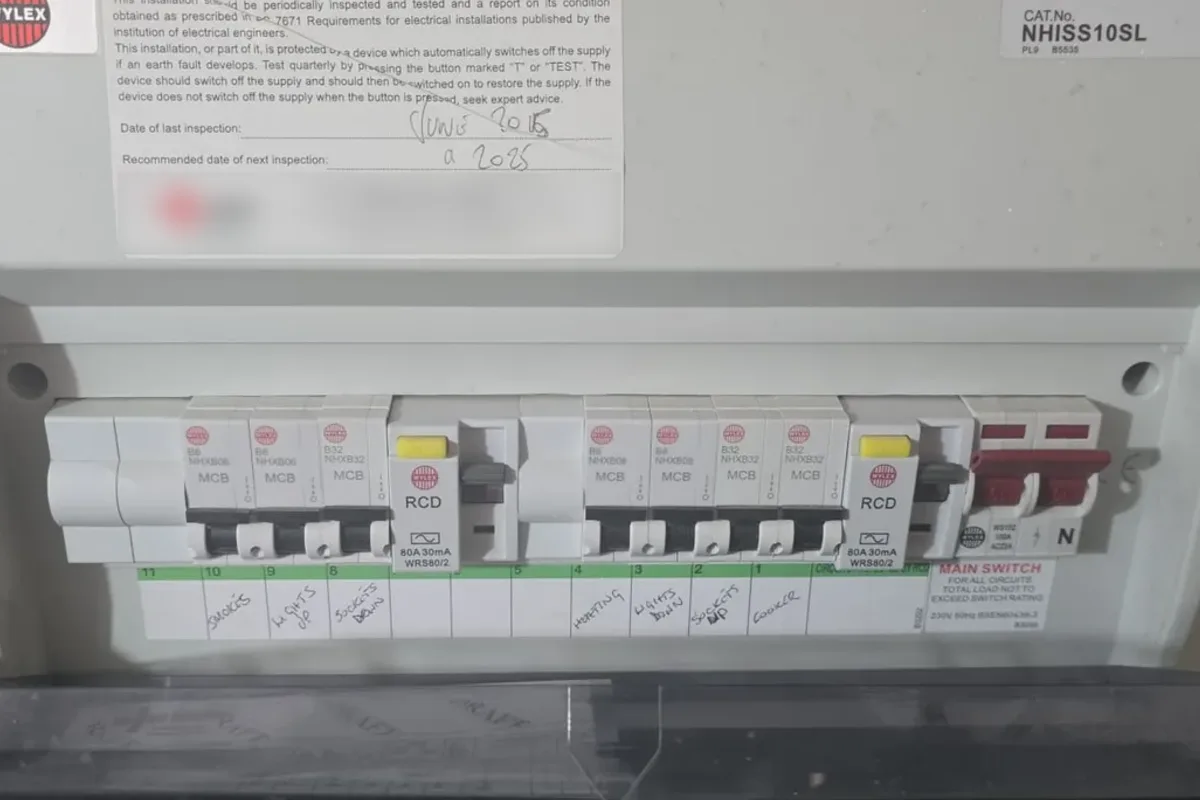
When the clocks go back on Sunday 25 October 2026, it is a good moment to test your smoke alarms and the RCD on your fuse board at the same time. There is more on that in why does my RCD keep tripping?.
Free help from the fire service
Both fire services that cover this area offer free home safety visits for people who need them. Depending on your circumstances, they may fit alarms for you as part of the visit.
- Goole, Howden and the East Riding: Humberside Fire and Rescue Service, which explains how to book a visit
- Selby, York and North Yorkshire: North Yorkshire Fire and Rescue Service, or call their fire safety advice line on 01609 788545
If you have an elderly relative living on their own, these visits are well worth booking.
When it is worth getting an electrician in
You do not need an electrician to put up battery alarms. Screw them to the ceiling, test them, and you are done.
It is worth getting one in when:
- You want mains-powered, interlinked alarms.
- You are doing a loft conversion or other building work where building control wants mains alarms.
- You are a landlord and want the alarms fitted, tested and recorded properly.
- Existing mains alarms keep going off for no reason, chirp after the batteries have been changed, or have passed their replacement date.
We fit and replace smoke, heat and carbon monoxide alarms, and our minimum charge of £102 including VAT covers the visit and up to an hour on site, so it often makes sense to do the alarms alongside another small job.
Common questions
Do I legally need smoke alarms in my own house?
Not in an existing house you own and live in, in England. You do if you rent it out, and new homes and some building work need them under building regulations. Having them is still the single cheapest fire safety step you can take.
Does a gas cooker need a carbon monoxide alarm?
Gas cookers are excluded from both the landlord rules and the building regulations requirement. Plenty of people fit a CO alarm in the kitchen anyway, particularly if the boiler is also in there.
Are heat alarms enough on their own?
No. Heat alarms are for kitchens and garages, where smoke alarms give false alarms. The government guidance is clear that heat detectors are not a replacement for smoke alarms.
My mains smoke alarm keeps chirping after I changed the battery. What now?
Check the date on the back first. If it is near or past ten years old, it needs replacing. If it is newer, the chirp can be a fault in the alarm itself. Mains alarms are wired in, so it is worth having an electrician swap them rather than taking them down yourself.
Want them sorted?
If you would like alarms fitted, swapped or wired in, ring us on 01904 599109 and Nathan will book you in. If you have a few small jobs on the list, ask about doing them all in one visit.
We cover Goole, Howden, Selby and the villages in between, and the York side for planned work.