
An RCD trips when it senses electricity leaking to earth somewhere on the circuits it protects. Most of the time the RCD is doing its job properly and the problem is something it is connected to: one appliance, a damp outside socket or light, or a damaged cable. The pattern of when it trips usually points you in the right direction, and there is a safe ten minute check you can do yourself before ringing anyone.
What an RCD actually does
An RCD (residual current device) compares the electricity going out along a circuit with the electricity coming back. If some of it is going somewhere it should not, usually to earth through damp, damaged insulation or a faulty appliance, the two no longer match. Most home RCDs are rated at 30 milliamps, and they are designed to switch the power off in a fraction of a second when the difference reaches that, often a bit before.
That is a small amount of current, which is the point. It greatly reduces the risk of a serious electric shock and cuts the power before a leak turns into something worse. So a tripping RCD is a warning, not the fault itself.
First, check what has actually tripped
Open the cover on your fuse board (the consumer unit) and look for the switch that is down. Not every switch on the board is an RCD.
| What you see | What it is | What a trip usually means |
|---|---|---|
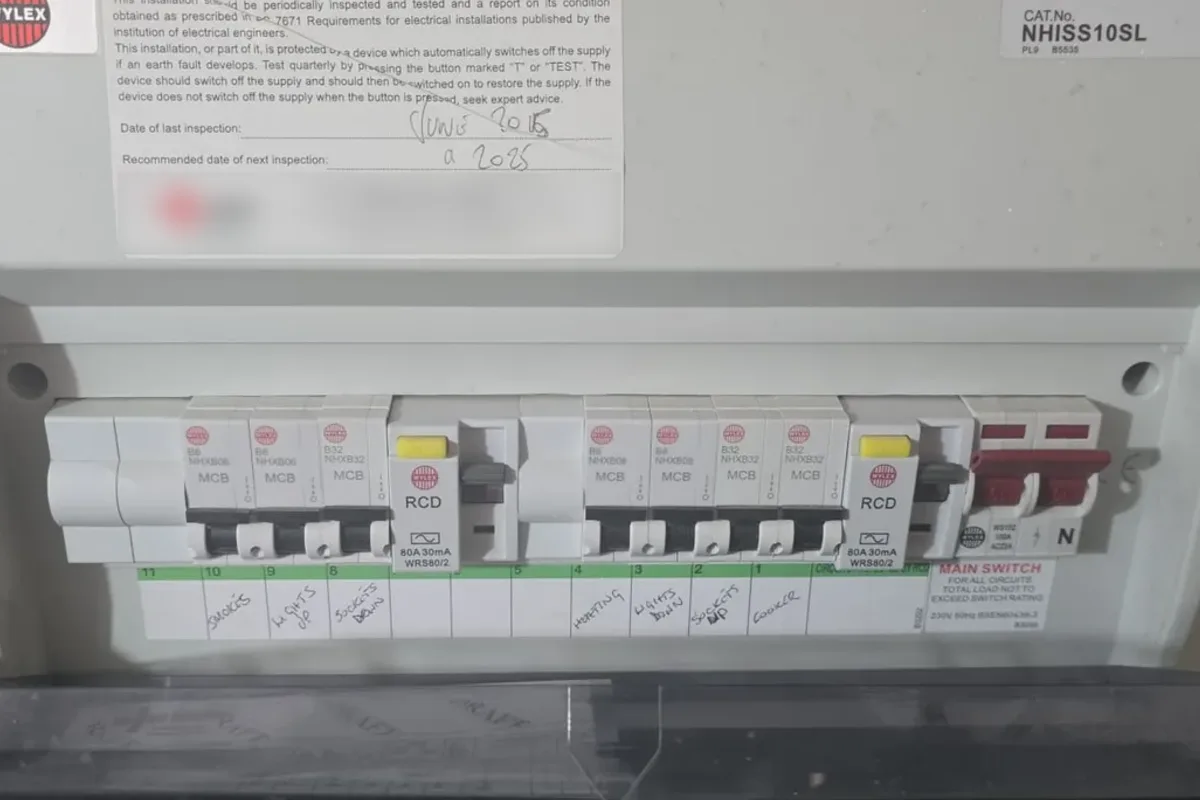
| A wider switch with a test button marked T or TEST, often labelled RCD | RCD, protecting a group of circuits | Electricity leaking to earth on one of the circuits it covers |
| A narrow switch marked with a letter and number, such as B6, B32 or C16 | Circuit breaker (MCB), protecting one circuit | Too much current on that circuit, or a short circuit |
| A narrow switch with its own small test button | RCBO, a breaker and RCD in one, protecting one circuit | Either of the above, but only on that one circuit |
| The large switch at the end, often red | Main switch | A plain main switch does not trip. If it has a test button, it is an RCD covering the whole house and can trip like one |
On a lot of boards fitted in the last fifteen to twenty years, the circuits are split between two RCDs, so one fault switches off roughly half the house. That is why a tripped RCD can take out the kitchen sockets and the upstairs lights at the same time, even though the fault is only on one of them.
If it is a single circuit breaker that keeps tripping rather than an RCD, the cause is different, usually too many things running on one circuit or a fault in an appliance or cable. The ten minute check below still helps.
What the pattern tells you
When it trips is often the best clue you have. Have a think about which of these sounds most like yours.
It trips when it rains, or on damp nights. Look outside first. Outdoor sockets, garden lights, shed and garage supplies and outside wall lights are the usual suspects, because water finds its way into fittings that were not sealed properly or have aged.
It trips when you switch on one particular thing. That appliance is the most likely cause. Kettles, washing machines, dishwashers, tumble dryers and the heating elements in ovens and hobs can all develop a leak to earth as they age.
It trips at the same time every night or every morning. Think about what switches on by itself at that time. Immersion heaters on a timer, storage heaters, outside lights on a timer or a dusk sensor, and fridge freezers running a defrost cycle all come on without anyone touching them.
It trips at random, with no obvious pattern. This is the awkward one. It can be a cable that has been damaged by a screw, a nail or a picture hook, rodent damage under a floor or in a loft, a fault that only appears when something warms up, or several small leaks from computers, televisions and chargers adding up on one RCD. This kind of fault usually needs test equipment to find.
It will not reset at all, even with everything unplugged. If the RCD trips again straight away with all of its circuits switched off, the fault could be the RCD itself, the board, or a fault on the neutral or earth wiring that the switches on the front cannot isolate. Leave it off and ring an electrician.
Using something on one side of the board trips the RCD on the other side. That points to a wiring fault where circuits have been connected in a way they should not have been, for example a shared or “borrowed” neutral. It is not something you can fix from the board, but it is very helpful to tell your electrician exactly what you saw.
The ten minute check you can safely do yourself
Everything here is done with the switches on the front of the board. You do not need to take any covers off, and you should not.
- Look and sniff first. If you can smell burning, see scorch marks, or a socket or switch feels warm, leave that circuit switched off and ring an electrician. If there is smoke or fire, get out and call 999. Only touch the board with dry hands, and leave it alone if it is wet, damaged or scorched.
- Switch off the circuit breakers covered by the tripped RCD. These are usually the breakers sitting next to it on the same side of the board.
- Reset the RCD. If it will not stay on with all of its circuits off, stop here. That needs an electrician.
- Switch the breakers back on one at a time. When the RCD trips again, the breaker you have just switched on is usually the circuit with the problem. Some wiring faults can confuse this test, which is one reason to note exactly what happened.
- Leave that circuit off and switch everything else back on. Most of the house should now work normally.
- If it is a socket circuit, unplug everything on it and switch off any fixed appliances at their wall switch, then try again. If the RCD now holds, plug things back in one at a time. If it trips when a particular appliance goes in, you have probably found your culprit.
- Write down what you found. Which circuit, what was plugged in, what the weather was doing, and what time it happened. It saves time, and time is what you pay for on a fault visit.
What not to do
- Do not keep resetting it over and over in the hope it will stay on. Every trip is the RCD telling you something.
- Never hold, tape or wedge an RCD or breaker in the on position.
- Do not take the front off the board, open up sockets or swap an RCD yourself.
- Do not carry on using an appliance that you think is causing the trips.
If it turns out to be an appliance
If one appliance trips the RCD every time it is plugged in, the fix is usually the appliance, not your wiring. That is a job for an appliance repairer or the manufacturer, and you may not need an electrician at all.
Built in appliances are different, because you cannot simply unplug them. If you suspect an oven, hob or immersion heater, switch off its circuit or its switch on the wall and ring me. I can test whether the fault is the appliance or the supply feeding it, so you know who you actually need.
If the problem is in the wiring
If the check above points at a circuit rather than an appliance, or the trips are random, it needs testing. On a fault visit we test the circuits to measure how well the insulation is holding up, which helps pinpoint where the leak is, rather than guessing from the symptoms. We also test the RCD itself to check it trips when it should, because an RCD that has worn out can trip when it should not, although that is less common than people expect.
You get a plain English explanation of what I found. Fault finding visits are from £102 including VAT, which covers the trip out and up to an hour on site. If it needs parts or more time, you get a price before I carry on, not after. There is more on how a visit works on the electrical fault finding page.
Does a tripping RCD mean I need a new fuse board?
Not necessarily. Plenty of tripping problems turn out to be one appliance, one outside light or one damaged cable, and the board is fine.
It is worth knowing the difference a newer board can make, though. With RCBOs, every circuit has its own protection, so a fault on the kitchen sockets only switches off the kitchen sockets rather than half the house. If your board is old, has no RCD protection on some circuits, or the RCD itself is failing, I will say so, and I will also say if it does not need changing. If you want to understand what an upgrade involves, the fuse board upgrade page explains it, including the typical prices.
Test your RCD twice a year
The test button is there for you to use. Pressing it should switch the RCD off straight away. Switch it back on and you are done. If it does not switch off when you press the button, ring an electrician. The button checks that the switch works. How quickly and how sensitively it trips is checked with test equipment during an inspection.
The IET, which publishes the UK wiring regulations, says the current regulations ask for this test every six months. Older boards often carry a label saying test it quarterly, like the board in the photo at the top of this page. The IET suggests doing it when the clocks change, which makes it easy to remember. The clocks go back on Sunday 25 October 2026, so that is a good time to do it.
Before you press it, save anything you are working on, because it will switch off everything on that side of the board. You will probably need to reset a few clocks afterwards.
If you look at your board and cannot find a test button anywhere, you may not have RCD protection at all. That is worth getting looked at properly. An electrical inspection (EICR) will tell you exactly what protection you have and what, if anything, needs doing.
When it is worth ringing an electrician
- The RCD will not reset even with all of its circuits switched off
- You have found the circuit, but not an appliance that explains it
- It trips at random and you cannot see a pattern
- You can smell burning, see scorching, or a socket or switch feels warm
- The test button does not switch the RCD off
- There is no RCD on your board, or only some circuits are covered
- You have tried the check above and you would rather someone tested it properly
Common questions
Is it safe to leave the faulty circuit switched off?
Usually, yes. Switching off the circuit that trips the RCD is the safe thing to do while you wait for it to be looked at. Just check what else is on that circuit, such as a fridge, freezer or anything medical, and make other arrangements if you need to.
Can an RCD trip for no reason?
An RCD can wear out, but it is not the most common cause of tripping. An old RCD is actually more likely to stop tripping when it should, which is what the test button is there to catch. It is worth ruling out the circuits and the appliances first, because replacing an RCD that was doing its job properly just moves the problem somewhere else.
My RCD trips during thunderstorms. Is that a fault?
Not necessarily. A surge on the supply during a storm can trip an RCD. If it only happens in storms and resets straight away afterwards, it is less likely to be a fault in your wiring. If it also trips in ordinary rain, treat it as damp getting in somewhere, and if it trips in dry weather too, do the check above.
The whole house has lost power and nothing on the board has tripped. What now?
Check whether your neighbours have power too. If they have also lost it, it is probably a power cut, and you can report it or check for updates by calling 105, the free national power cut number for England, Scotland and Wales. If it is only your house and nothing on the board has moved, ring an electrician.
Can you come out tonight or at the weekend?
We do not run an out of hours service. We work Monday to Friday, 8:30 to 5. If it happens in the evening, find the circuit with the check above, leave it switched off, and ring in the morning.
Need a hand with it?
If your RCD keeps tripping and you have run out of things to unplug, ring us on 01904 599109 and tell us what you have found. Nathan usually answers. Or send a photo of your board on WhatsApp with a line about when it trips, and I will tell you what I think before anyone comes out.
We cover Goole, Howden, Selby and the villages in between, and the York side for planned work.